


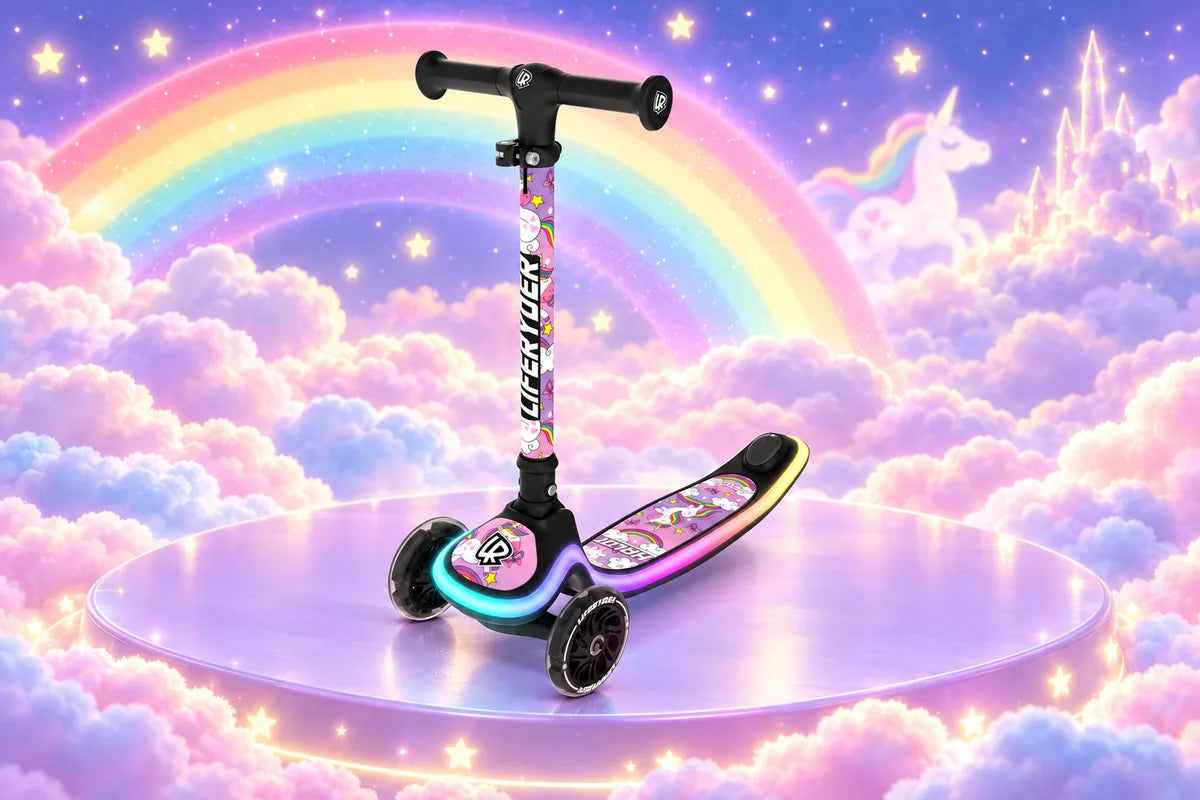
For many three-year-olds, a lightweight three-wheel scooter with lean-to-steer control is a useful starting point. The best choice is the one that fits your child, feels manageable and suits how they want to ride. Lights and a favourite design can add to the excitement, but check the steering, handlebar fit and brake first.
This LIFERYDER buying guide explains what to look for in a scooter for a three-year-old and where our HALO three-wheel scooters fit in. HALO is designed for ages 2 to 7, so the same checks also help when buying for a two- or four-year-old.
Should a three-year-old have a two-wheel or three-wheel scooter?
Start with the child's experience. A three-wheel scooter gives a young rider a different starting point from a two-wheel model: they can practise pushing, steering and stopping with two wheels at the front and one at the back.
HALO uses lean-to-steer control. Your child guides it by leaning from side to side, rather than turning the handlebars like a bicycle. That difference matters if they have tried another scooter before. Allow time to learn the steering in a suitable place.
Three wheels do not remove the need to learn or prevent falls. Check the manufacturer's age and size guidance, supervise young riders and follow the supplied instructions. Our QUEST two-wheel scooter starts at age 5, so it is not our recommendation for a three-year-old.
Five things to check before buying a toddler scooter
1. Handlebar fit
Choose an adjustable handlebar and check the child can hold the grips comfortably in a relaxed, upright position. They should not need to stretch forward or crouch to reach them. Age is a guide, not a substitute for checking fit.
HALO has an adjustable handlebar and is intended for riders up to 130 cm tall, with a maximum rider weight of 50 kg. Check the individual product details before ordering. If you are unsure about a smaller child's fit, ask our team for help choosing.
2. A weight they can manage
A scooter needs to work for the child pushing and manoeuvring it, and for the adult who may carry it home. HALO weighs 2.6 kg. Think about lifting it over a kerb, storing it at nursery and carrying it alongside everything else on a family outing.
3. Steering they understand
With HALO, a gentle lean changes direction. Before the first outing, explain the movement and help your child practise on a flat, suitable surface away from traffic. A child accustomed to handlebar steering may need time to get used to leaning instead.
4. A brake they can reach
HALO has a rear foot brake. Show your child where it is and help them learn to stop before attempting a longer ride. A correctly fitted helmet and the protective equipment recommended in the instructions belong on the preparation list too.
5. Storage and carrying
If the scooter will travel in the car or share a hallway with coats and shoes, folding is worth considering. HALO has a one-click folding frame for carrying and storage. Folding is an adult task: follow the supplied instructions and check the scooter is correctly secured before use.

Choosing a light-up three-wheel scooter
Lights are often the feature children notice first. With HALO, there are two different lighting systems to understand:
- LED wheels: powered by the wheels turning, with no batteries needed for the wheel lights.
- Colour-changing RGB deck: powered by 3 × AA batteries, which are not included.
If you are buying a light-up scooter as a present, put the deck batteries on your list. The wheel lights work when the scooter moves. Choose the scooter for its fit and riding style as well as its lights.
Is HALO a suitable first scooter?
HALO is an option to consider for a three-year-old who is ready to try scooting and fits the model's size guidance. It combines three wheels, lean-to-steer control, an adjustable handlebar, a rear foot brake and a folding frame.
Its small PU wheels suit everyday scooting on suitable smooth surfaces. Think about the places your family will use it, rather than choosing on looks alone. If your child has not tried lean-to-steer before, introducing that movement is part of getting started.
If your child is asking for a unicorn scooter, HALO Unicorn combines pink and lilac unicorn, rainbow and star graphics with the same HALO scooter platform. Choose the fit and riding style first, then a design they will enjoy.
Choose a design that feels like theirs
A favourite design can make a first scooter feel special. HALO includes waterproof, removable EVOLV™ graphics. The look can be refreshed with replacement scooter sticker sets as your child's interests change. Choose a set intended for the HALO model.
The scooter arrives assembled, with the included graphics to be applied before use. Leave time for that step if you are preparing a birthday or Christmas present, then follow the setup checks in the instructions.
Questions parents ask about scooters for three-year-olds
Can a two-year-old use the same scooter?
HALO's suggested age range starts at 2, but a younger child's size, ability to reach the controls and readiness still matter. Check their fit and supervise them as they learn. An age label does not mean every child will be ready at the same point.
Will a three-wheel scooter still suit a four-year-old?
It can. HALO is designed for ages 2 to 7, subject to fit and rider limits. There is no need to move to two wheels just because another birthday arrives.
Do the lights need charging?
The wheel lights are motion powered and do not need charging. The RGB deck uses 3 × AA batteries, not included.
Is this a scooter with a seat?
No. HALO is a standing kick scooter. It does not convert into a seated ride-on.
Choosing their first LIFERYDER scooter? Explore HALO light-up three-wheel scooters and check the model details before picking their favourite design.
Enjoy the journey.
Choosing a Scooter for a 5 or 6-Year-Old: HALO or QUEST?
Light-Up Kids’ Scooters for Christmas 2026: Which One Should You Choose?